Continual Learning with Elastic Weight Consolidation for House Tree Person Test
Mentors Dr. Christine Cha, Associate Professor in the Child Study Center, Yale University & Dr. Ellen Lee, Postdoctoral Associate in the Child Study Center, Yale University
Abstract
Background
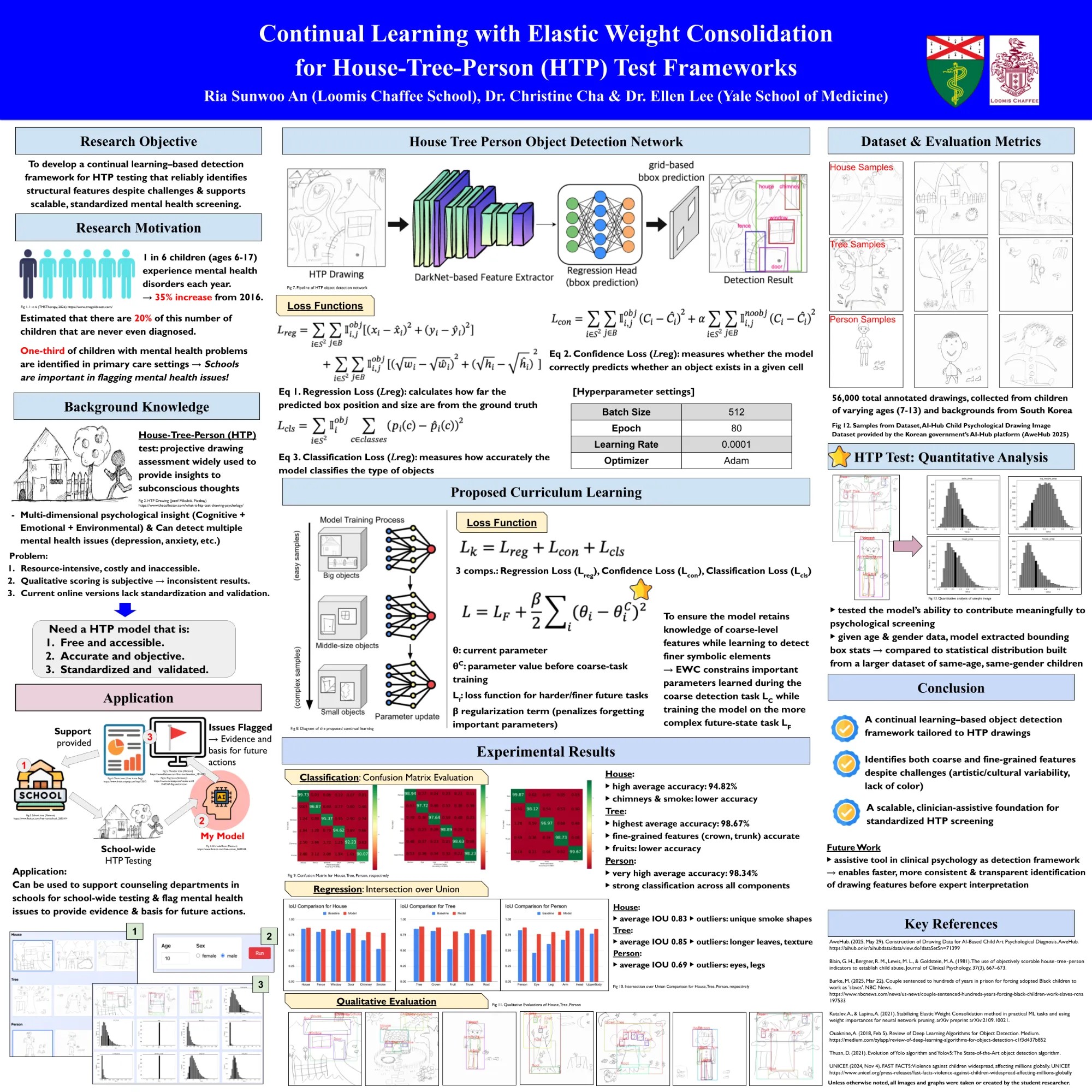
Child mental health issues are often undetected due to children’s limited ability to recognize or communicate their emotional states. The House-Tree-Person (HTP) test is a commonly used projective drawing assessment for identifying subconscious emotional and cognitive patterns in children, yet its clinical utility is constrained by high administration costs, subjectivity, and lack of standardized online versions.
Methods
This paper presents a novel web-based HTP analysis framework that leverages object detection to automate and standardize interpretation. Processing HTP drawings with machine learning models poses several challenges. These drawings are grayscale, lacking detailed information, and exhibit high domain variance due to the diverse drawing skills of individuals across different ages.
To address these challenges, this paper focuses on improving object detection performance for HTP drawings. We introduce a continual learning strategy with Elastic Weight Consolidation (EWC) to prevent catastrophic forgetting across tasks of increasing difficulty, enabling the model to adapt from coarse- to fine-grained recognition progressively.
Results
This approach significantly enhances detection accuracy and spatial precision, achieving 94–99% classification accuracy and an average Intersection over Union (IoU) of 0.82–0.84 across HTP categories. A simple web-based visualization interface has been developed only to demonstrate the practical deployment of the trained detection model.
Conclusion
This work underscores the importance of robust object detection as the foundation for future automated and interpretable psychological assessments.
Highlights
- Pending publication
- Presented at the Connecticut Science & Engineering Fair (CSEF) ’26 and the Youth Suicide Research Consortium (YSRC) ’26
- 2nd Place, Infosys Foundation USA Computer Science Award, and J.A. Augustine and H. Glista Special Awards at CSEF (Mar 2026)