Investigating Collagen-Induced Fibrin Fibrillogenesis in the Absence of Thrombin
Mentors Dr. Miriam Rafailovich, Distinguished Professor, Stony Brook University & Dr. Adam Hansen, Stony Brook University
As a scholar in the Garcia Research Scholars Program, I was drawn to research approaching human health at its smallest scale. Under the guidance of Dr. Rafailovich and Dr. Hansen, three other scholars and I spent summer '26 investigating how collagen can drive fibrin fiber formation without thrombin, the enzyme normally required for clotting. We traced this interaction to a specific region of fibrinogen's αC domain (Aα414–505), revealing a possible mechanism behind the dense, treatment-resistant clots found in stroke patients. Because these fibers form on a controlled material surface, our approach could lay the groundwork for lab-based tests that detect abnormal clotting before it becomes dangerous. The project showed me how materials science could become a tool for understanding, and ultimately engineering, human health.
Lab notebook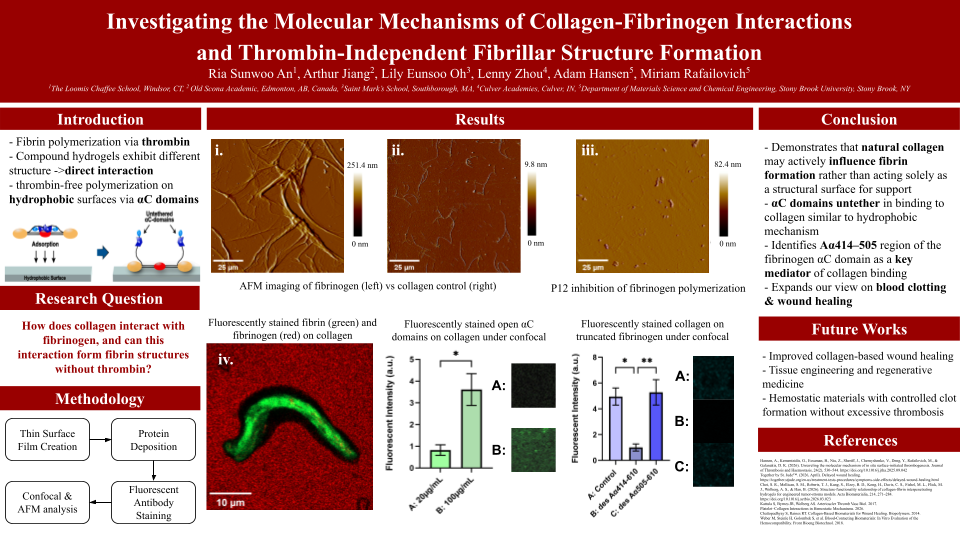
Abstract
Background
The development of materials for in vitro assessment of thrombotic disease requires measurable indicators of the molecular processes underlying abnormal clot formation. Clot architecture is clinically relevant: acute ischemic stroke thrombi possess compact outer shells that resist fibrinolysis1, while collagen incorporation in fibrin clots has been shown to render fibrin less accessible to fibrinolytic enzymes, impeding thrombolysis2. These findings motivate investigation of collagen-fibrinogen interactions as potential contributors to persistent clot structures. Recent studies demonstrate that surface-induced untethering of fibrinogen αC domains contributes to fibrillogenesis in the absence of thrombin3, suggesting that material interfaces offer a means to probe assembly mechanisms under controlled conditions. However, whether collagen also supports fibrillar assembly in the absence of thrombin and which αC-domain interactions govern this process remains poorly understood. Here, we investigate how collagen-fibrinogen interactions and adsorption promote fibrillar assembly in the absence of thrombin and determine the contribution of fibrinogen αC domains in this process to inform future in vitro assays of abnormal fibrinogen assembly.
Methods
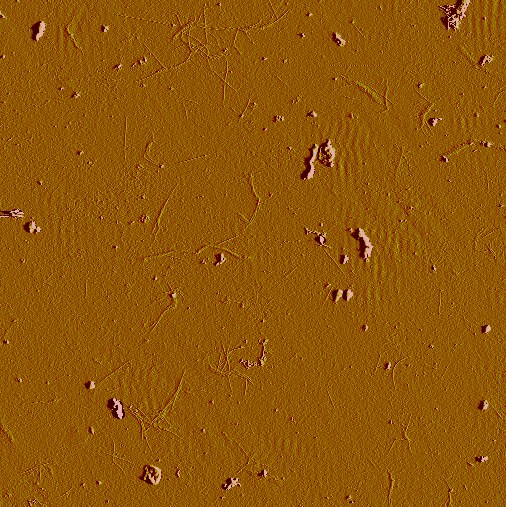
Interaction of fibrinogen with a collagen surface was first tested by leaving silicon wafers in solutions of 5µg/mL and 50µg/mL neutralized type I telocollagen for 18h to deposit collagen thin films. 20µg/mL, 100µg/mL, and 4mg/mL solutions of fibrinogen were then left to adsorb on the wafers for 1h and 18h and imaged with atomic force microscopy (AFM). Confocal microscopy with fluorescent antibody staining was then conducted using anti-Aα1-16 (anti-FpA), anti-Bβ14-15 (anti-knob B), and anti-Bβ122-134 to identify fibrinogen, fibrin, and untethering of αC domains, respectively. In addition, 50µM P12 solution, a fibronectin-derived antithrombotic that binds to the N-terminal subdomain of the αC domain,4 was mixed with 3.96 mg/mL fibrinogen solution and deposited for 18h to examine inhibition of fibrillogenesis. To further investigate involvement of the αC domain, 50µg/mL fibrinogen solutions with truncated αC domains (des Aα414-610, des Aα505-610) were deposited for 30min on silicon wafers to create thin films. 5µg/mL collagen solution was then left to adsorb on the fibrinogen films for 30min and examined by staining with anti-collagen type I.
Results
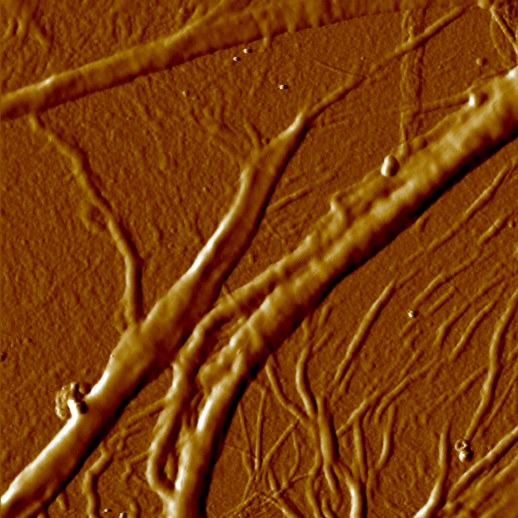
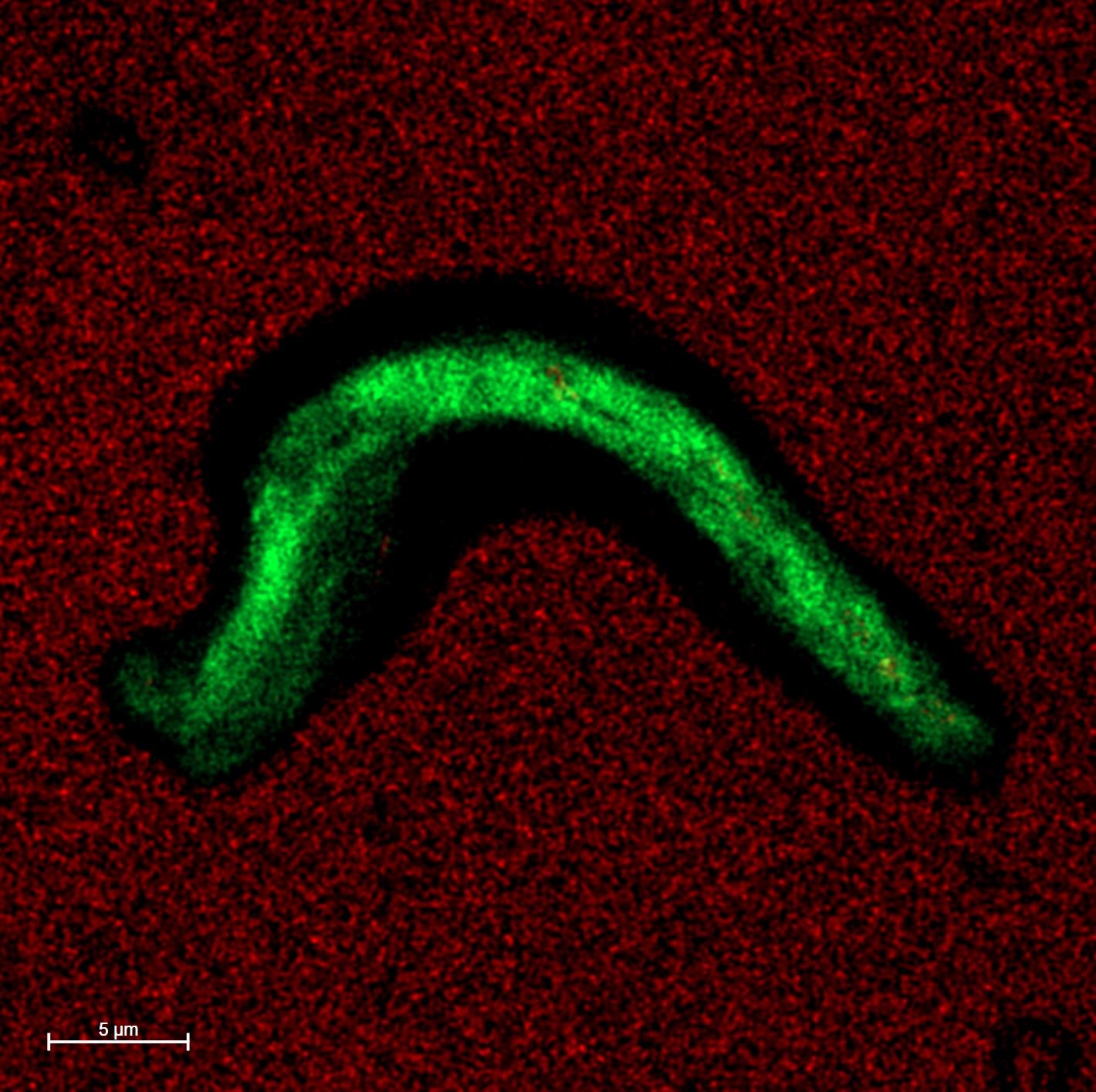
Large fibres were observed on hydrophilic collagen films (contact angle of 26.55°), demonstrating that interactions between the two proteins result in thrombin-independent fibrillar assembly. Anti-FpA and anti-knob B stained samples revealed that assemblies were composed of polymerized fibrin lying within cavities of a bed of fibrinogen. Fluorescence intensity of anti-Bβ122-134 stained samples increased with adsorption time, demonstrating formation of layers of fibrinogen with open αC domains on the collagen surface similar to the hydrophobic mechanism. Reduced fibrillogenesis was observed following P12 treatment, further suggesting that these interactions are mediated by the αC domain. Fluorescence intensity of anti-collagen type I was significantly lower when adsorbed to fibrinogen des Aα414-610 compared to a negative control and des Aα505-610, confirming that the Aα414-505 region within the N-terminal subdomain of the αC-domain is responsible for adsorption.
Conclusion
These findings suggest that collagen promotes fibrillar assembly in the absence of thrombin through interactions involving the Aα414-505 region of fibrinogen’s αC domains. Structural and antibody-based fluorescence measurements capture changes in this process following domain truncation and P12 treatment, providing measurable readouts of collagen-associated assembly. This establishes a controlled in vitro approach for investigating a potential mechanism of pathological clot formation and may inform future material-based assays for assessing thrombin-independent fibrinogen assembly.
Highlights
- Presenting at the Materials Research Society (MRS) conference, Dec '26 @ Boston
References
- Di Meglio L, et al. “Acute ischemic stroke thrombi have an outer shell that impairs fibrinolysis.” Neurology. 2019;93:e1686–e1698.
- Mirshahi M, et al. “Defective thrombolysis due to collagen incorporation in fibrin clots.” Thrombosis Research. 1988;Suppl 8:73–80.
- Hansen A, et al. “Unraveling the molecular mechanism of in situ surface-initiated thrombogenesis.” Journal of Thrombosis and Haemostasis. 2026;24:530–544.
- Hansen, Adam, et al. “Peptide-Mediated Inhibition of Surface-Initiated Thrombogenesis.” Journal of Thrombosis and Haemostasis, 27 June 2026, https://doi.org/10.1016/j.jtha.2026.06.029.