Association of Social Determinants of Health with Incident Mental Health Outcomes in US Veterans
Mentor Dr. Peter Na, Assistant Professor of Psychiatry, Yale University
I’m often intrigued by questions that clinical data alone cannot answer, and this was one of them: Why do some veterans develop mental health conditions while others facing similar experiences do not? Under the guidance of Dr. Peter Na, I investigated how social determinants of health, from economic circumstances to social connection, correlate with new mental health outcomes among U.S. veterans. By looking beyond symptoms to the environments in which they emerge, our research identified social factors that may reveal vulnerability before it reaches the clinic. This project pushed me to ask not only how we treat mental illness, but what we might notice earlier if we looked beyond the clinic.
DOI: 10.1177/00207640261449691International Journal of Social Psychiatry (2026)Highlights
- Published in International Journal of Social Psychiatry, May 2026
- Poster presented at Medical Education Day at Yale ’26
Abstract
Background
Evidence underscores the substantial influence of social determinants of health (SDOH) on mental health. Understanding whether the cumulative burden of adverse SDOH predicts risk for mental health outcomes may guide prevention strategies and inform SDOH-focused clinical and policy interventions.
Objective: To evaluate the predictive utility of a composite SDOH score for incident mental health outcomes and to identify specific SDOH most strongly associated with mental health risk.
Methods
Design: Population-based, 3-year longitudinal cohort study using three waves of the National Health and Resilience in Veterans Study (median survey dates: November 21, 2019; November 14, 2020; and August 18, 2022).
Setting: General U.S. adult population.
Participants: Nationally representative sample of military veterans who did not screen positive for each outcome at baseline.
Main outcomes and measures: Self-report measures of internalizing disorders (major depressive disorder, posttraumatic stress disorder, generalized anxiety disorder), suicidal ideation (SI), and substance use disorders (SUDs).
SDOH composite score: 21 indicators from Healthy People 2030 and related SDOH frameworks, across five domains.
| Domain | Indicators |
|---|---|
| Economic conditions | Multidimensional deprivation index, Childhood economic hardship, Employment status, Housing tenure (own vs. rent vs. temporary), History of homelessness |
| Education | Highest educational attainment |
| Healthcare access | Health insurance coverage, Need for assistance to attend medical appointments, Transportation barriers to mental health services, Difficulty scheduling mental health appointments |
| Neighborhood & built environment | National area deprivation index, State area deprivation index, Housing type and stability, Community engagement, Perceived community integration |
| Social & community context | Cumulative adverse childhood experiences, Military sexual trauma, Exposure to traumatic events, Received social support, Provision of social support, Interpersonal difficulties |
Results
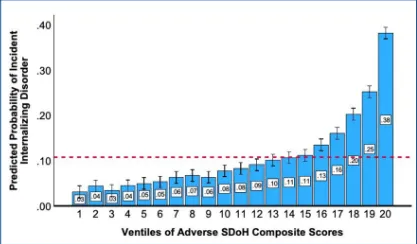
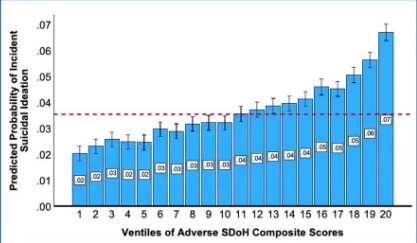
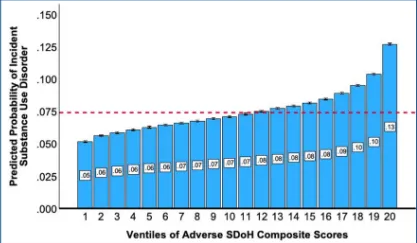
In multivariable logistic regression models, greater baseline SDOH composite scores significantly predicted incident internalizing disorders (OR=2.12, 95%CI=1.78-2.53, p<.001), SI (OR=1.30, 95%CI=1.01-1.68, p=0.04), and SUDs (OR=1.34, 95%CI=1.14-1.58, p<.001) over the 3-year study period. Veterans in the highest 5% of SDOH burden were more than 12 times more likely to develop an internalizing disorder, 3.5 times more likely to develop SI, and 2.5 times more likely to develop SUD relative to those in the lowest 5%.
Post-hoc analyses identified key SDOH domains independently associated with outcomes. Lower community integration/ social support, psychosocial difficulties, cumulative traumas, and un/under-employment were independently associated with incident internalizing disorders (all p<0.01). Lower received social support and greater psychosocial difficulties were independently associated with incident SI (all p<0.02). Lower community integration and greater adverse childhood experiences were independently associated with incident SUD (all p<0.01).
Conclusion
Cumulative SDOH strongly predicted onset of adverse mental health outcomes among US veterans. Key risk factors such as social disconnection, unemployment, psychosocial difficulties, and early-life adversity, highlight potential targets for prevention and intervention. Findings underscore the importance of SDOH-informed clinical and policy approaches, such as social prescribing, employment assistance programs, and trauma-informed strategies, to reduce mental health burden and suicide risk in veterans.
Poster
Medical Education Day at Yale, 2026
From Social Risk to Psychiatric Risk: Implications of Social Determinants of Health for Mental Health Training
Read the poster abstract
Objectives
To develop a structured medical education framework that integrates training on social determinants of health (SDOH) into mental health care curricula, informed by longitudinal data demonstrating strong associations between cumulative SDOH burden and incident internalizing disorders (major depressive disorder [MDD], posttraumatic stress disorder [PTSD], generalized anxiety disorder), substance use disorders (SUDs), and suicidal ideation (SI) among U.S. military veterans.
Background
Longitudinal data from the National Health and Resilience in Veterans Study with a nationally representative sample of U.S. military veterans demonstrate that cumulative adverse social determinants of health (SDOH) burden significantly predict incident psychiatric outcomes over a three-year follow-up period. Multivariable analyses indicate that greater baseline SDOH burden is associated with elevated risk of developing internalizing disorders, suicidal ideation, and substance use disorders, with veterans in the highest burden group demonstrating markedly increased psychiatric risk compared to those in the lowest burden group. Specific determinants such as social disconnection, adverse childhood experiences, psychosocial stressors, and unemployment or underemployment, were independently associated with incident outcomes. These findings highlight the central role of social risk in psychiatric vulnerability and the necessity for a structured training in SDOH-informed mental health assessment and intervention.
Methods
Building on this evidence, we propose integrating structured SDOH training into medical curricula through targeted educational strategies. Current training often emphasizes symptom recognition, medication, and family history, with less structured attention to social determinants of health (SDOH). Integrating formal instruction on validated SDOH screening tools such as standardized social risk assessments used in primary care and behavioral health settings, would equip trainees to systematically recognize social risk as psychiatric risk. Training learners to incorporate SDOH screening results alongside traditional clinical assessments would promote more comprehensive diagnostic conclusions and risk evaluation. Case-based learning modules could further reinforce how social vulnerability contributes to psychiatric outcomes and helps learners identify opportunities for prevention and early intervention within their real-world patient interactions. Additionally, curricula should include practical instruction in community resource referral pathways, interdisciplinary collaboration with social workers and care coordinators, and general understanding of how insurance coverage affects access to supportive services. Embedding structured SDOH assessment and response strategies into medical education may help future clinicians deliver more comprehensive, prevention-oriented, and structurally informed mental health care for high-risk populations such as veterans.
Conclusions
These findings highlight important implications for medical education and clinical training. First, they underscore the need for structured training on SDOH screening, interpretation, and intervention strategies within medical education. Second, they support incorporating trauma-informed care principles and interdisciplinary approaches, including social prescribing, employment support referral pathways, and community resource navigation, into clinical curricula. Third, they suggest that improving clinician competence in recognizing social risk factors may facilitate earlier identification of individuals at elevated psychiatric risk, thereby informing targeted prevention and early intervention efforts. Educational innovations in this area may improve patient outcomes while also helping trainees develop a more comprehensive understanding of health in the context of SDOH.