Continual Learning with Elastic Weight Consolidation for House Tree Person Test
Mentors Dr. Christine Cha, Associate Professor in the Child Study Center, Yale University & Dr. Ellen Lee, Postdoctoral Associate in the Child Study Center, Yale University
During a child psychiatrist talk I attended with the Cha Lab, I became fascinated by the House-Tree-Person test, an intersection of art and mental health, both my major focal points. A simple drawing could offer clinicians clues about a child’s psychological state, but I found out that interpretation could be subjective and difficult to scale.
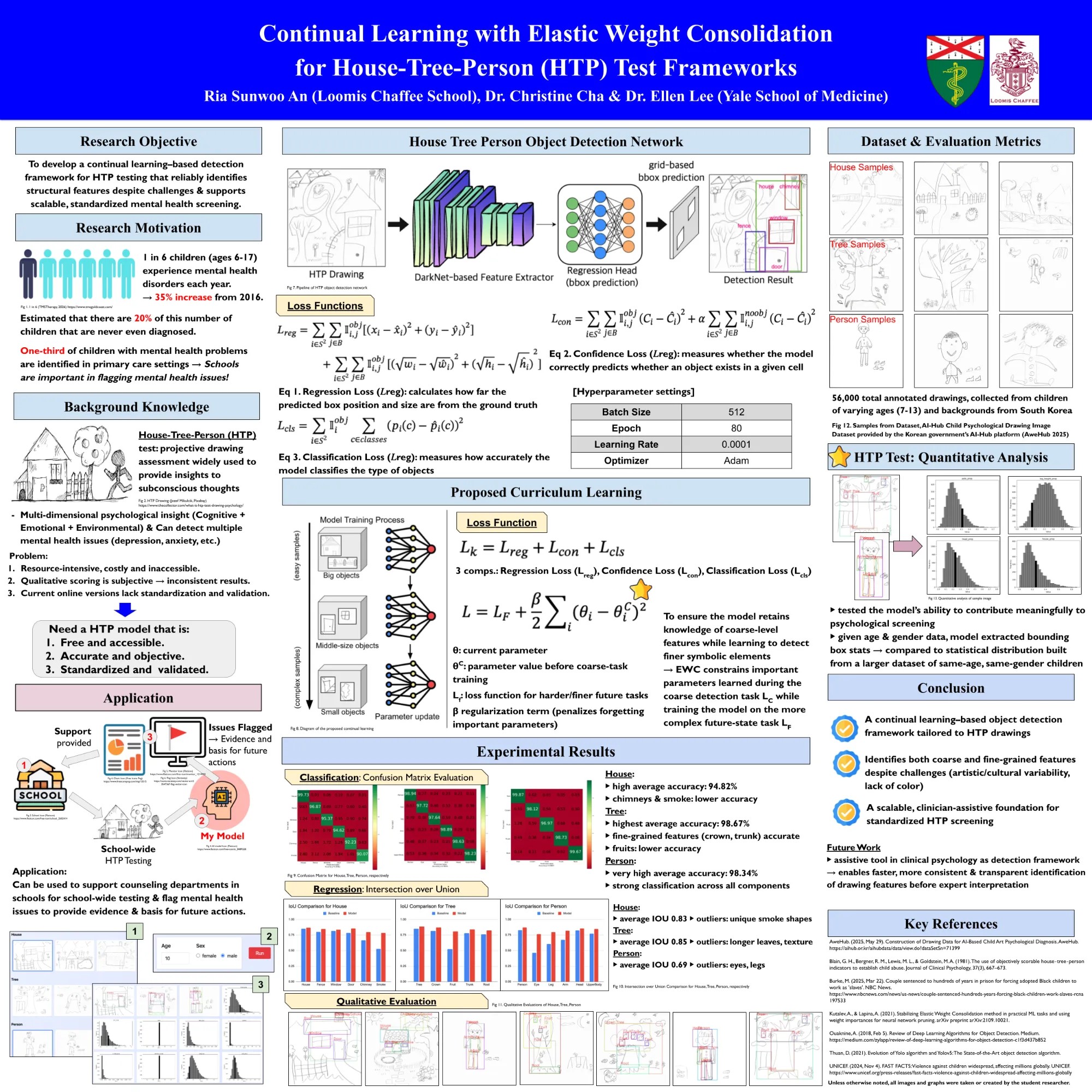
Under Dr. Christine Cha and Dr. Ellen Lee, I developed a computer-vision model that detects features in these drawings while using Elastic Weight Consolidation to learn new features without forgetting previously learned ones. The approach improved mean IoU from 0.73 to 0.83, with particularly large gains in subtle features such as smoke, fruit, and eyes. By bringing continual learning to psychological assessment, I was able to develop a model that grew with what it learned, especially as real psychological data does not arrive all at once. I began to see adaptability not as a technical feature, but as a principle for designing around something as complex and changing as a person.
Research logbookHighlights
- Pending publication
- Presented at CT Science & Engineering Fair ’26 & Youth Suicide Research Consortium ’26 ↗
- 2nd Place, Infosys Foundation USA CS Award & J.A. Augustine & H. Glista Special Awards, CSEF ’26
Abstract
Background
Child mental health issues are often undetected due to children’s limited ability to recognize or communicate their emotional states. The House-Tree-Person (HTP) test is a commonly used projective drawing assessment for identifying subconscious emotional and cognitive patterns in children, yet its clinical utility is constrained by high administration costs, subjectivity, and lack of standardized online versions.
Methods
This paper presents a novel web-based HTP analysis framework that leverages object detection to automate and standardize interpretation. Processing HTP drawings with machine learning models poses several challenges. These drawings are grayscale, lacking detailed information, and exhibit high domain variance due to the diverse drawing skills of individuals across different ages.
To address these challenges, this paper focuses on improving object detection performance for HTP drawings. We introduce a continual learning strategy with Elastic Weight Consolidation (EWC) to prevent catastrophic forgetting across tasks of increasing difficulty, enabling the model to adapt from coarse- to fine-grained recognition progressively.
Results
This approach significantly enhances detection accuracy and spatial precision, achieving 94–99% classification accuracy and an average Intersection over Union (IoU) of 0.82–0.84 across HTP categories. A simple web-based visualization interface has been developed only to demonstrate the practical deployment of the trained detection model.
Conclusion
This work underscores the importance of robust object detection as the foundation for future automated and interpretable psychological assessments.