A Deep Semi-Supervised Domain Generalization Approach for Epileptic Seizure Prediction using EEG
Mentor Kobi Osei-Mensah, Science Faculty, The Loomis Chaffee School
My first major research project began from a memory of talking with a girl who lived in constant fear of seizures during a hospital volunteer service. As I dug into the current research, I found a limitation in seizure-prediction models: an EEG pattern useful for one patient or device may not translate cleanly to another. Under Mr. Kobi Osei-Mensah, I developed a deep semi-supervised domain-generalization approach that separates seizure-related information from patient-, device-, and noise-specific variation in EEG signals. By learning representations that preserve clinically meaningful patterns while reducing irrelevant differences, I explored how seizure prediction could become more reliable beyond a single dataset or laboratory setting. The project, now patent-pending, introduced me to engineering as a way to bridge the gap between an algorithm that works and a technology that works for people.
Highlights
- AAAI Special Award ↗, Regeneron International Science & Engineering Fair (ISEF) ’24
- Engineering 1st & Physical Science 2nd (both ISEF qualifiers), CT Science & Engineering Fair ’24
- Biotechnology 2nd & MTU Aero Engines Engineering Innovative Concept Award, CSEF ’24
- Patent pending: US 18/534,777, Method & Apparatus for Extracting Neurological Disorder from EEG
- Published in Journal of Student Research, 2024
Abstract
Background
Epilepsy is a neurological disorder characterized by random, recurrent seizures: sudden, uncontrolled bursts of electrical activity in the brain. Currently, 1 in every 26 people in the US has epilepsy, 50 million are affected worldwide, and 1 in 3 patients have drug-resistant epilepsy, where medication cannot control their seizures, so the best solution is prediction.
Previous seizure prediction research most commonly trains a Convolutional Neural Network on 2D EEG signal graphs. These models have two significant limitations: they are biased to the EEG datasets and devices used to train them (overfitting), and they are extremely sensitive to noise such as blinking, coughing and movement, so they cannot be used in daily life.
Methods
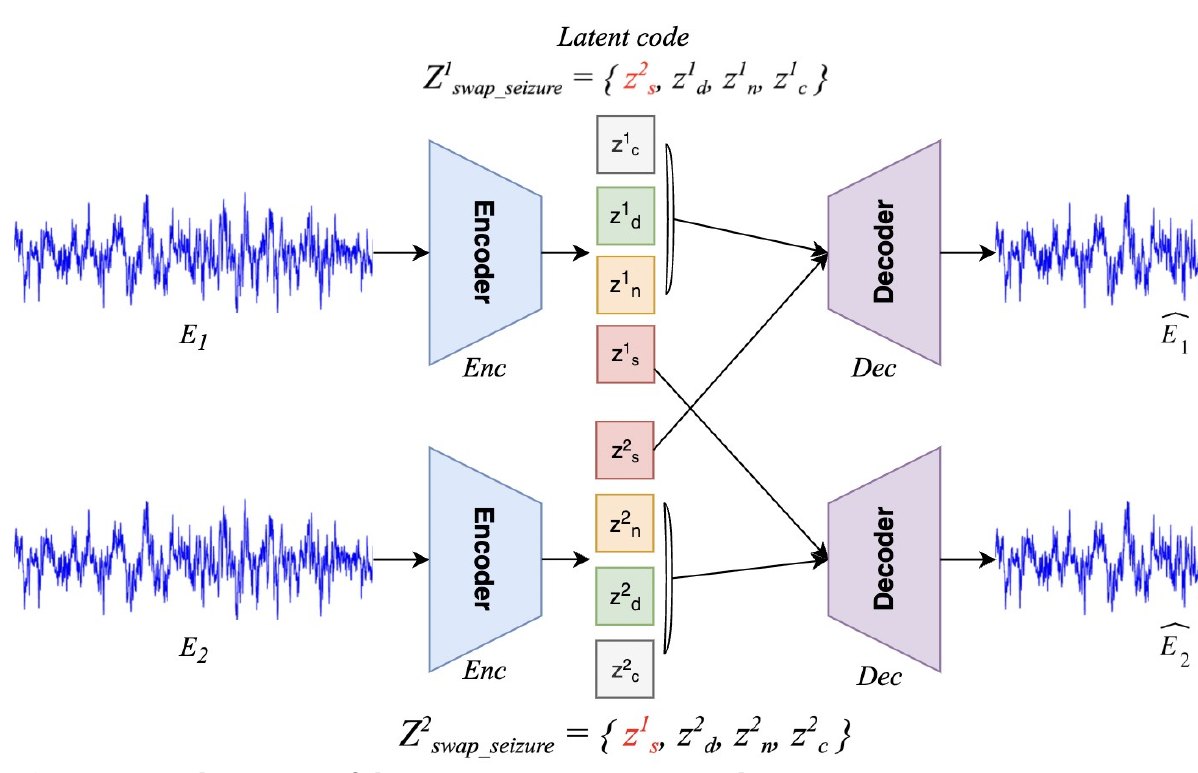
The objective of this research is to develop a novel seizure prediction model using a semi-supervised deep learning technique that solves both problems. The model receives EEG signals as an input and goes through two phases. In the representation learning phase, an autoencoder with a new Feature Swapping Mechanism disentangles the seizure-, device-, noise-related and common features of the EEG signal and extracts only the seizure-related features. In the transfer learning phase, a Seizure Classifier trains on these features and outputs the probability of a seizure occurring.
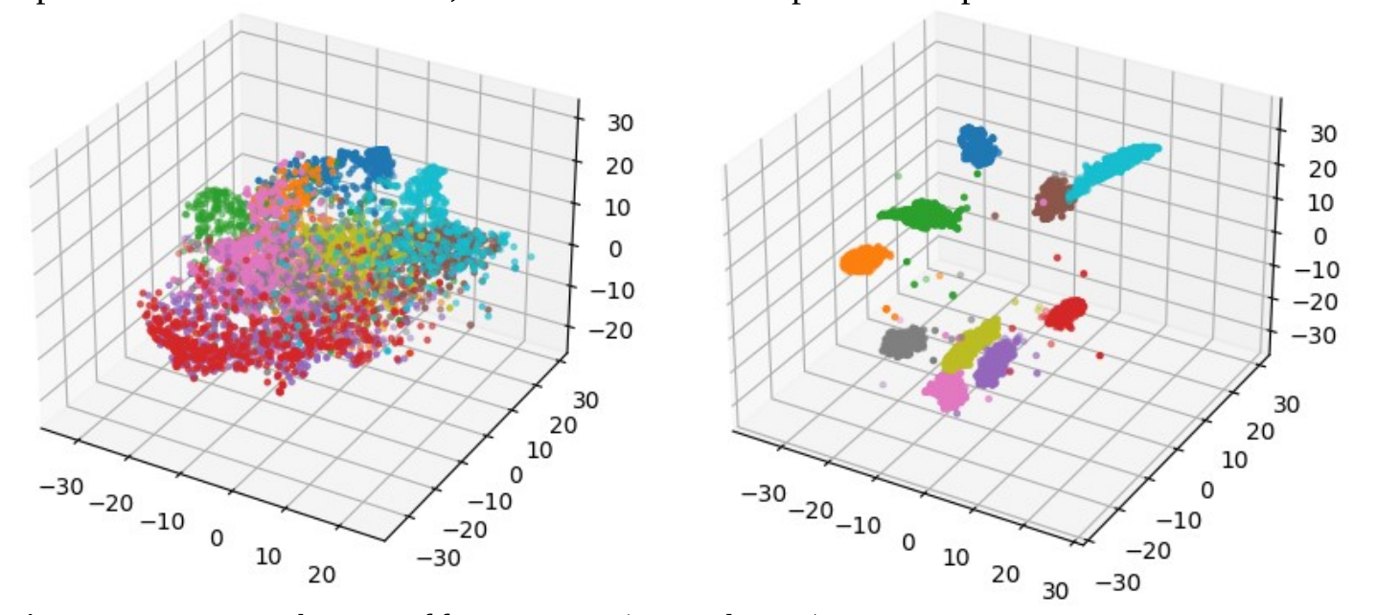
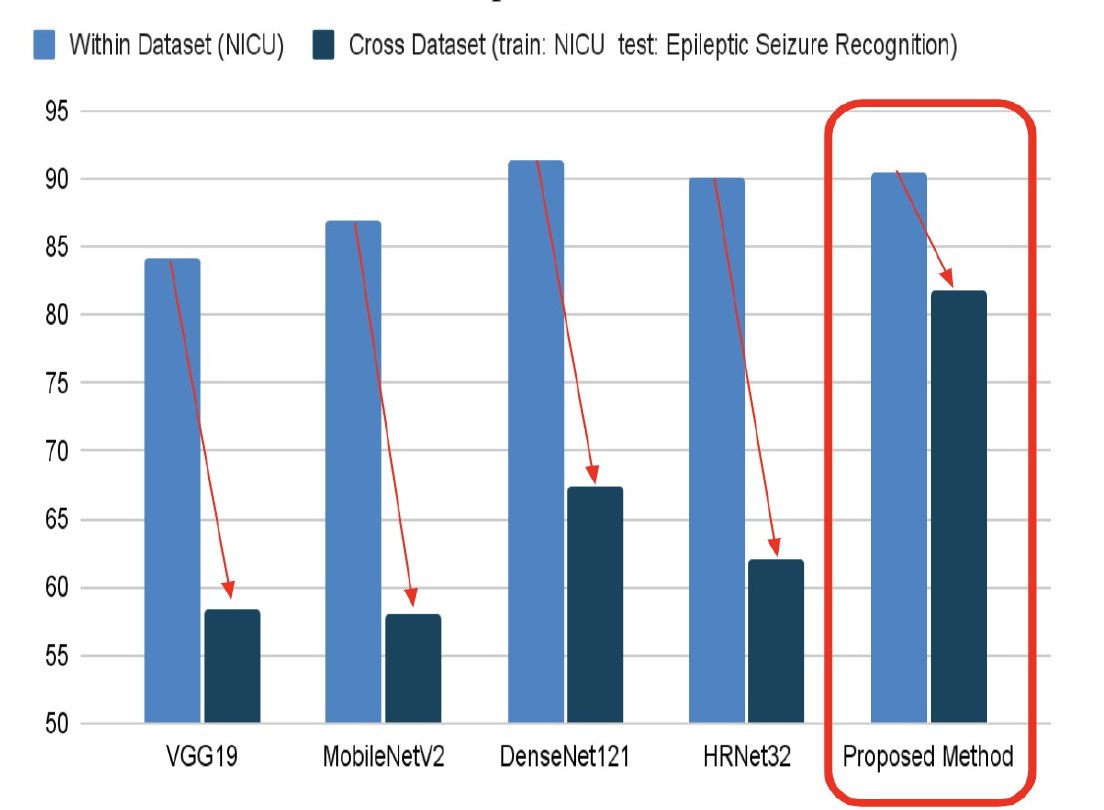
The model was evaluated on the NICU dataset (46,640 neonatal EEG samples from 79 individuals) and the Epileptic Seizure Recognition dataset (11,500 samples from 500 individuals), with t-SNE feature map visualization, within-dataset evaluation and cross-dataset evaluation.
Results
The model achieved exceptional performance, with an accuracy of 92.70% in the within-dataset evaluation. The model outperforms the previous methods by 19.35% in the cross-dataset evaluation. Lastly, the t-SNE feature map visualization proves the validity of the Feature Swapping Mechanism.
Conclusion
I developed a seizure prediction system utilizing transfer and representation learning phases, taking EEG signals as an input and outputting the probability of a seizure occurring. The model has high accuracy and solves the problems of bias on datasets/devices and sensitivity to noise. A low-cost (~$71) wearable prototype built from a baseball cap and EEG electrodes shows the feasibility of a device that alerts patients before a seizure.